Showing posts with label Fable. Show all posts

Sunday, February 20, 2011

Popular Mechanics: The Catharsis Button

Like many avid male gamers with significant female counterparts, I want my fiance to be a gamer herself. I spend no small amount of effort, sometimes to her chagrin, on the task. While I realize that it may be dangerously close to "wanting to change" someone, I don't feel it's the same. I enjoy getting into her interests and, like those, I see it as something we can do together. Some of my best bonding moments with friends have been over video games. Furthermore, I just don't get how someone could NOT be into video games. It's like someone saying they don't like music. I can believe that they don't like what they've heard and know of, but that there is no music in the world for them seems absolutely impossible and incredibly sad.
Ladies, just think of it as a picnic with space marines.
In my attempts at winning her over, I have had many setbacks, but also a few wonderful, if small, victories. I can count the number of games she really enjoys and will pick up at her own volition on one hand, but she also eats those things up. Amongst the titles that she's grown enamored with is A Boy and His Blob. She expressed interest when I bought a copy for my little sister, so I had to immediately go out and pick up a copy for our own home.


So, all of this has beating around the bush finally leads to the actual topic of this post, a feature of A Boy and His Blob I like to refer to as the "catharsis button."

Pressing up on the Wiimote's D-Pad causes "the boy" to hug Blob. This serves no practical purpose. There is no secret way it kills the final boss, no gameplay trick, they just share a hug - accompanied by an impossibly cute little noise she says should be spelled "nnnnnnnnnnnnnn."
"And the Grinch's heart grew three times that day."
So, why, as a designer, do I think that's in there? Well, the entire game is built around the relationship between "the boy" and Blob - so of course there's that aspect. In that sense it's a far more effective version of Lionhead's attempt at integrating touch as a mechanic in Fable 3. On occasion, I've noticed her hugging Blob expressly because of how many times she's had to manipulate him over the course of a level, or due to some frightening fall. He's her partner, and she feels the need to show her appreciation for him. It's beautiful really. That is, however, a purely affective use. Though that holds equal weight, I do believe the action serves an objective function. Catharsis.

As my fiance plays through the game, she will occasionally come upon situations that result in repeated failures. After such incidents she will, inevitably and without prompting, hug Blob. Watching over her shoulder, it's obvious what effect this has on her. She's releasing the pent up frustration she's developed with the game. In many places where, in other games, she would have gotten annoyed and walked away from the title forever, she has simply hugged Blob a couple of times, relaxed and pressed on anew.

This is, of course, a familiar course of action to many gamers. Many a time have I either intentionally thrown a protagonist into certain death for this purpose. When life gets me down, few things pick me up better than a good old fashioned GTA murder spree. In no other game, however, have I ever seen this effect either so serenely or concisely captured.
I have such fond, sociopathic memories of this parking garage.

This, combined with the games very calm soundtrack, leads the platforming puzzler to be one of the least frustrating experiences I've played, despite the fact that it presents no lack of challenge.

Monday, January 24, 2011

Sequelitis: Fable 3

So, a while back I made a post about Fable 2, discussing how I believed the sequel has developed the original games ideas and how I think the series should move forward. Well, Fable 3 is actually out now, so let's look at what's occurred.

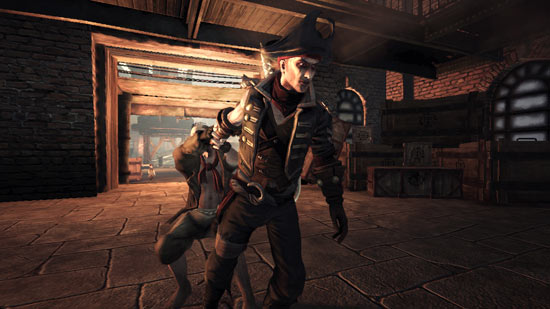
Image used for no reason other than that my hero looks exactly like that guy. With a sweet witch-hunter hat, of course.
Now, while this won't be a review, I should start by providing a general assessment of the game's quality, if only to contextualize the arguments herein. I enjoyed the game. I didn't feel it was overly short as, taking my time to take advantage of all of the content the game had to offer, it actually took me longer to be done with Fable 3 than Fable 2. The core storyline missions may possibly be shorter, but I got more hours of fun out of it than its predecessor. That being said, I still wrung it dry in less than a week, so I recommend it, but only as a rental or, as was my case, a borrow. I've heard a lot of people I normally agree with decry it as being absolutely horrible, but most arguments I've heard tend to be very nit-picky, focusing on a few things they hated. In a Peter Molyneux game, however, one must realize that he's going to throw a lot of stuff at the wall and, though not everything sticks, you're getting more experimentation in a title than you're gonna get in almost any other AAA title.

To start with the good, Fable 3 finally begins to do what Peter Molyneux has been promising it would from the very start. You actually do have a noticeable affect on your world that has started to move beyond the token and into something of actual consequence. Rather than the pair of binary choices presented in the previous game, there are many ways in which I may make my Albion different from yours. I may or may not have a chicken racing track, Albion lake, a brothel or an orphanage, a ruined or well kept city, an inspiring castle or black fortress, a thriving metropolis or deserted ghost kingdom, etc. In the end it just boils down to more multiple choice options, but the far higher number has begun to leave enough variables to have interesting results.

More importantly, these decisions are now tied into the actual game-play and narrative. Ones actions may now have unintended consequences. This, moving forward, should be an essential element in developing player influenced worlds. Without accidents, the world would be a much more banal place. I, for one, did not intend to become Albion's beloved and benevolent murderer king, but that's what happens when your gun accidentally goes off in a crowded market. So much the better.

Why can't I both renovate the orphanage AND build a brothel? I like babies and boobies. Is that so strange?
This being said, this mechanic still suffers from unnecessarily moralistic mechanics. There is absolutely no subjectivity to the game's decisions, to the point that you are always explicitly provided with both an objective moral assessment of the available choices and their certain results. You will never regret a mistake because, unlike the real world, everything is an absolutely known quantity.

The same issue leaks into the confusingly simplified NPC interactions, wherin you can simply tap Right Trigger to know every character's life story and you always know exactly how anyone will react to any given interaction.

In comparison, the most effective piece of game design in the oft panned Prey was a sequence early in the game involving a rather nasty machine, seen in the below video (not my own).


Basically, it's a conveyor belt of death ending in overkill via impaling. Impractical, but impressive. During this introductory sequence, the player gets off of the "conveyor belt" and is attempting to free the others, including his grandfather and lady-friend. During this process, the player does manage to stop the device. Then this happens (again, video not my own):


The player, passing through yet another alien hallway, spots a button facing the machine. Due to human curiosity and years of video game conditioning they, in all likelihood, press it. I know I did. The machine is reactivated and the player watches as his grandfather dies. You have jumped without looking, made a mortally serious mistake, and one which you have absolutely no hope of recovering from. Now, I could be wrong on some specifics here. Maybe the game does force you to press the button to continue. Maybe the game entirely ignores this wonderful moment of drama from there out. I wouldn't know. It is, however, irrelevant. All that matters is the impression that this perceived decision makes upon the player. The voice actor need not even say it. "What have I done‽"

Fable 3, to return to our subject, explicitly denies the players any chance of such revelatory moments, either for good or ill, and thus denies them a chance at emotional connection with the game.


The other issue here is that, much like the previous title, this approach limits replayability. As the player already knows what the alternative would have been, they have little motivation to spend another day of their life to see it actually play out. There is also no real variety, as the vast majority of players will, due to the game's binary morality system, choose either all of the good or evil options, meaning that of all the possible combinations, only 2 will really be seen online. This approach has limited the game's variety, when I lighter touch would have effectively multiplied the content on the disc without actually having to produce any more.


As I'd feared, Molyneux has also dabbled a little too much in novel concepts which haven't really come to much. Before release, for example, he made a huge deal out of the new hand holding mechanic, claiming that it delivered a great emotional connection to the NPCs. Not only does it not, but the mechanic doesn't even work. You constantly loose your grip on the NPCs, and a person being dragged off too jail, a buddy being led home after a long night of drinks, and a bashful first date all act exactly the same when the mechanic comes into play. The obvious goal was to capture a little of the drama of Ico, but it was a gimmicky waste of time here.
Bullshit
What "dragging" a criminal to prison actually looks like.
-Set to "Happy Together" by the Turtles
Overall, I'd say the game was an improvement over its predecessor but, in trying to streamline some mechanics, the dev team accidentally oversimplified some. Simplicity is a worthy goal, but not at the cost of depth. There is a balance there which, hopefully, the eventual sequel will be able to strike.


What I want to see in Fable 4:
- Moral ambiguity. Mass Effect's "Superman" vs "The Punisher" morality system not only makes more sense within the pre-set hero narrative, but is far more compelling.
- Better weigh simplicity vs depth. I found the NPC interactions and melee combat to be a bit watered down from the previous installment, but could not think of a single way in which these had improved the title.
- NPCs, beyond the supporting caste, that do not seem like mindless automatons. The constant encouragement to emotionally invest in, marry, and have children with these NPCs seems outright creepy to me at this point. In this area, the Fable series has achieved an uncanny valley, not of anatomy, but of persona. The Sims, for example, do at-least seem like simplistic caricatures of human personalities.
- Don't have the game constantly tell me to buy DLC. Hearing John Cleese shill for premium dye colors was down right pathetic.
- Don't charge for DLC, such as dye colors and varying dog breeds, which seem like fixes to glaring problems with the original release.
- Keep the interactive "menu" system. It's gotten a bit of guff due to its imperfections, but it's a solid step forward that should be embraced as a stroke of genius game design.
- Keep building on Albion as a growing place while showing us older parts we remember. Maybe even steal some Mass Effect 2 style cross-game influence. It really helps unify the series.

Friday, August 27, 2010

Sequelitis: Fable 2

Sequelitis is another in what will become the regular features of this blog. In these articles, I will examine a game with an implied, likely, or announced sequel, and discuss what changes, improvements, etc. are neccessarry in order for that sequel to be justified and successful.
___
With Fable 3 now clearly on everyone's collective radar, and soon approaching. I figured I might give some brief thoughts on my experience with Fable 2, and what improvements to the formula I believe should be made for the sequel.

While designer Peter Molyneux has a reputation for wild exaggerated claims, this title actually lived up to most of them. For those that were fans of the original Fable, there was little to be disappointed in.

 Fable 2 is set in the same world as the original, Albion, with the timeline advanced by 500 years. The game makes only passing references to the original, so one need not have played it to understand the plot of the latest chapter. Then again, this may not necessarily be a good thing. An opportunity was missed here to take the Mass Effect rout and deliver on some of Molyneux's promises about the original Fable. Choices made in the final acts of Fable 1 could have effected the world and player character, such as their lineage (assuming they descend from the original game's hero), the state of Albion (depending on the original player's alignment and influence in the world, and the existence of some NPCs (depending on weather or not you killed your sister and other NPCs.) This would have retroactively given the studio a bit  better favor over the perceived lies surrounded Fable 1, allowing them to spin these as very long term intentions.

The biggest change from the first game lies in the streamlined combat system. Now the player has one button each to control melee, magic and ranged weapons, including guns. This sounds overly simplistic, but the system is build around context. Mashing a button as quickly as possible has one effect, holding it has another, and pressing it rhythmically has yet another. Making a melee attack against an attacking foe executes a riposte, while attacking an enemy near a ledge, wall, or other environmental feature produces another effect. This really works, providing a fun and cinematic game that's quite easy to get into regardless of skill level. It's reminiscent of Assassin's Creed, though less rewarding of your commitment than that somewhat more complex system. For Fable 3, I'm totally on board with these design philosophies. Just layer on more depth and you should be set. More contextual actions, interactive environments, variety in the moveset, etc. Some of what was shown in pre-release media (see screenshot below aswell) implied a bit more depth to the system, but there's no reason that couldn't be 100% accurate and then some for the follow up.

Looks pretty, but fence jumping is in no way integrated into combat. In the actual game, this was  a bad decision.
Molyneux has exaggerated on a few counts however. The world does not shift as dynamically as he suggested and the co-op play is serviceable, but poorly implemented.

At two particular points in the game's storyline, locally limited changes to the geography will occur. These are binary and determined solely by the player's choice of quests. When one of these changes occurs, the game explicitly points them out. Therefore, even if you haven't seen the alternative outcome, you'll know what it would have been. All of the possible outcomes can be seen in only two playthroughs. Nobody will ever be surprised by someone else's game world. I felt more control over my world in GTA: Vice City, buying up properties left and right, than I ever did here. Moloneux needs to go back to the drawing board and found where he hid all those wonderful acorns. For the sequel, I believe they should focus less on these huge overarching shifts and more on the details. Simple economic systems, based not only on what the player buys and sells but on their actions, would go far. If I kill a blacksmith, the town should be out of a blacksmith for a while. The prices of metal items should go up in the absence of a local distributor. His old shop will become devalued, and, though the player may buy the property himself, eventually a new smith will move in to fill the niche. Though this type of thing may be somewhat complex, Fable is quickly becoming outpaced as other RPGs are implementing these kinds of features. Fable will not be able to continue existing as a franchise if it's one shining, unfulfilled promise becomes overshadowed by the realities of the market.

In co-op play, the second player can import the stats of his own character, but not their avatar. Six pre-made avatars are available, none of which are aesthetically pleasing. The game tethers players together with an invisible rope, one that is often smaller than the battles, so you'll constantly bicker over control of your collective direction. The camera doesn't aid much either. I love co-op when it works, but here it feels rather tacked on. The game as a whole is an RPG - but the co-op experience is strictly hack n' slash. In several instances, I intentionally logged off of the game during story-heavy sections in order to make things easier on the primary player. Bad sign. We've already heard plenty of talk about the improvements to this system in the sequel, so I believe I can chalk up the obvious improvements to be made as taken care of.

What makes a Fable game are two things, a relatively simple setup easily acceptable to more casual audiences, and the ability to do many non-combat activities in town. Both are present and improved on here. There are more of these extra curricular activities available, but they remain minor distractions. The money earning mini games are absolute busy work - monotonous and ill-conceived. Those more enjoyable mini-games still feel somewhat tacked on and none of them will bring me back to the title. Contrast this with Red Dead Redemption's mini games which, while merely versions of classic gambling games, are handled with so much finesse and atmosphere that they are my go-to way to play blackjack, poker, and liar's dice when I lack human company. If it doesn't add to the game, it detracts. This was one of the few areas, for me, where the company's commitment to polish really seemed to fail. Hopefully, in Fable 3, everything you can do will be something someone might actually want to.

The other half of the non-combat activity is intended to be your interaction with the world and it's people. This functions almost identically to how it had in the original Fable, with only a few extra bells and whistles to provide token improvement. I've felt far more connected to my character, the world, and the NPCs in games like the Mass Effect series than I ever did in any Fable game. This is largely because Fable's NPCs are a very predictable hoard of simplistic automatons. You know, absolutely, that, if you just keep spamming these three emotes, every identical woman in town will fall in love with you. Visually and emotionally, they are all alike. There is no mystery to it. It is for this reason that the only NPC with which I felt any empathy was my dog. While not perfect, they did get the essential element, to me, of NPC companions. They are not you. You do not control them. You can not ever fully know them. The dog, to some degree, has a mind of his own. He will take actions without orders and, while still rather predictable, is never entirely so. This logic needs to be applied to all NPCs in the Fable world.
All of these women find fart jokes hilarious.
I very much enjoyed Fable 2. There's no real replay value there though. After playing through the full story, which I did twice over my rental period, the remaining open-ended quests are pretty much busywork. It's not a game like "Oblivion" that takes weeks of play to fully experience. It's a great rent for RPG fans, but far from a must buy.

Going forward into Fable 3, what I'd really like to see is an overhaul of the clunky co-op system and some real depth added to the extra curricular activities. The first, which we have already been promised, is really the only objective gameplay problem in the title. The latter is what Moloneux, it seems, has always wanted to make Fable about - but, in my opinion, has yet to succeed in. The minor ways in which the world can be influenced are all very direct, predictable, and functional. It all feels so very sterile. Hopefully the next title will really dig in, get dirty, and provide us with a real playground.

My fear, however, is that Moloneux's wonderful tendency towards experimentation might bight him in the ass again. You see, he's big on new ideas. An important part of what makes Lionhead a unique development house is that they do a lot of experimentation. Mr. Moloneux encourages his team to prototype original ideas. These quick prototypes, however, are uncommon because a prototype that doesn't carry into an actual feature is essentially wasted money on the business level. More common with Moloneux, I think, is that what works ends up being these odd little quirky things which aren't necessarily what the audience was looking for. The dog in Fable 2, for example. I thought it was great, but I would have preferred that the promises about the interactive world to have been fulfilled.

This being said, I am looking forward to Fable 3. Many of the concepts the dev team have mentioned aren't so much based on improvements to the Fable 2 formula as referendums on standard gaming tropes as a whole. As a designer, it's hard not to love listening to the guys as Lionhead and to look forward to their new products.

If you enjoyed this post, please subscribe!