Showing posts with label Portal. Show all posts

Sunday, May 29, 2011

Did Bethesda Just Make A "Date Game?"

I love me some co-op. I can pretty safely say I find gaming the most fun when I'm co-operating with friends. If many of my best memories of such are from 2 player scenarios, it's simply because I've very rarely been able to get more than 2 of my friends to get the same game on the same console at the same time in order to organize larger scale games. That, and the fact that the industry's recognition of this practical matter has lead to a few absolutely excellent 2 player co-op options.


Yet, this trailer doesn't exactly make me want to grab my usual co-op buddy and give the game a run through. Something about the (excellent) song choice, the available characters, and overt sexual tension makes me think that scenario could get a bit uncomfortable.

"Dude, I'm not checking out your ass!" "Then why is my tank behind me?"
Actually, it looks as if the game may best be played not with my buddy, but with my lady. She's not a big gamer, but she is loving our co-op trip through Portal 2 right now. Maybe I could present this as a "well, we just beat this. How about this next?"

The very idea strikes me as novel in the industry. In film, the "date movie" is an absolutely classic cash-in. It's a simple excuse for him to ask her out. She'll agree because, either way, she gets a free movie out of it. If they're already together, she'll force him to see it anyway. In every scenario, the studio makes bank regardless of the product's quality.

Did Bethesda inXile Entertainment just make the first real "date game?" Previous games have been good for playing ON dates, but this looks positively designed for a male/female co-op experience. (Sorry for my LGBT friends, but it's gonna be a bit before you notice any developments in this field.)  The growing camaraderie between the characters even hints that their might be a love story in here. Hell, the dialog might even end up qualifying it as a romantic comedy.

Could have worked as a horror FPS.
And the thing is, if it is, Hunted: The Demon's Forge could work so much better than When Harry Met Sally or Pretty Woman ever did. (Those are the only 2 rom-coms I, as a man, am allowed to remember exist) First, the guy is actually guaranteed to be engaged with the activity at hand, rather than simply waiting out the "we've now been sitting next to each longer long enough for you to touch me" phase of a first date. More importantly, the couple is actually engaging with one another. Movies are passive, but a game requires you to actually communicate, the key to building any kind of a relationship.
The place where we first met.
Partner refuses to provide you with vital intel? Bad communicator. Rushes ahead rather than taking on obstacles as a team? He's the center of his own world. Willing to thrown himself between you and waves of enemies while you hog the glory of the kill? There's a keeper.
Fencing skills are all I look for in a woman.
Worst case scenario, such a genre would give me something to drag my fiance to. And, really, such a move shouldn't surprise me. The disproportionate split of male/female gamers is shrinking every day. As games move from traditional male-centric design perspectives, and we see more quality content aimed directly at women, it seems that seeing rom-coms on consoles is more of an eventuality than anything else. I just hope they stay as fun as Hunted looks like it's going to be.
This is what threatens your relationship in the third act.

Friday, February 25, 2011

In Defense of FortressCraft

Okay, as the preface to the last post states, I made a bit of a gaff with the last post. I'm going to come out and say that first. I insulted both FortressCraft and its developers based purely on playing Minecraft and watching videos of FortressCraft.
aaaand this is your face on uninformed journalism.
On the games, FortressCraft is not a complete product. Moreover, I have never played FortressCraft. There's the big rub noone's really bashed me on that someone should have. Yeah, we've seen videos, but as a group of people that is so often mislead by pre-release marketing that's something we should know never tells the whole story. Had I not played Nier I would have assumed it was identical to any other samey JRPG, rather than a flawed but eclectic spin on the genre as akin to Darksiders as Final Fantasy. Therefore, I have exactly zero place making any assessment of FortressCraft's actual status. Is it a ripoff or not? I duno - I'll have to wait for the release to find out.

As for the designer, I made some personal jabs that were uncalled for and entirely based in conjecture. Those I entirely retract and apologize for. Bashing indie devs based on the unfinished production they've shown is no better for the industry than the perceived issue I so lambasted previously. Furthermore, the guy had the balls to step up and state his case, which he did in a relatively civil manner. On the internet, that says quite a bit.

In the interest of fairness, I'm not going to retract anything. Online, it comes off as if you're trying to change history and  rewrite what you said. So the last article stays up - with this one as an addendum. Am I backing down? No. Was I totally right? No. Do I seek to align myself better with what is, in fact, right? Yes. Seems to often that people online are completely unwilling to modify their stances in light of debate. You're right - the other guy is wrong. Forever. No matter what. If that's gonna be the case though, what's the point of a debate at all?

So, what mislead me? Well, I made two mistakes.

1) I foolishly assuming that "independent" is always synonymous with "starving artist and dependent on the kindness of strangers" because, after all, some people aren't wannabe devs - but people who've been in and out of the industry for years and have DECIDED to be independent.

You see, I'm aware of the history of Minecraft, how their business model works, and I've played the game to explore its design. These were known quantities to me. I knew of its critical and popular success, but did not really examine its financial success. Now, I know that should not have any bearing on the matter. Steal a dollar from  homeless man or from Richard Brandson, it's all theft. Still, the fact that Mojang apparently turns $350,000 A DAY on their indie project at last count does tend to color the picture somewhat. It lends credence to the developer of FortressCraft's assessment that Minecraft is not so much a beta as a gold release with regular updates. It at least makes my casting of Mojang in the fragile victim position somewhat laughable.

2) I addressed a very specific case, not as an illustration, but as if it were the issue in and of itself. The SHOULD have been an article about how derivative works affect the medium. By focusing one one case, I made my argument here dependent on a subjective assessment: "is game A a ripoff of game B." What I SHOULD have done and will endeavor to correct shortly is spoken about this from a more theoretical perspective.

The basic argument here SHOULD have been that when you copy something directly, without innovation, you get one of two results:
A) You blow the original out of the water, either due to quality, marketing, or market control, and damage the bottom line of the other guy.
B) You don't succeed in beating the big guy at his own game, and produce something inferior with no more worth than what already existed before your efforts. It's just another piece of shovelware only selling to grandmothers who don't know the difference and buy purely by cover art.

My assessment was really that when A happens to an independent developer, it's not only unfortunate but bad for the industry as it discourages creativity and innovation.

That being said, being informed by something is not the same as ripping it off. Darksiders, for example, takes several gameplay mechanics whole hock from other games. They, however, congeal into a wholly original and new whole. Anyone who's played both Portal and Darksiders' "Portal section" will tell you that, though the latter's inspiration is clear, the gameplay mechanics are entirely different.

FortressCraft is Bad For Gaming (?)

(edit: Full disclosure - the ? in the title is new. In discussion, I've learned a bit more about this than original research had turned up. Check both the comments and the next article for discussion on that. In summary though: I retract my assessment that FortresCraft can objectively be called a "clone" of Minecraft and the idea that FortressCraft will significantly damage Minecraft's bottom line. The bit about it scaring other developers away from that business model though - that's still sound.)

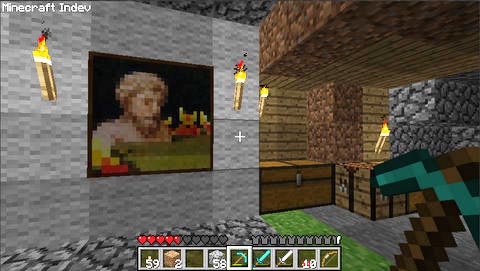
You all know Minecraft right? Indie game? Big hit internet sensation? The current darling of artsy game connoisseur types - a title previously held by the likes of Limbo (meh), Braid, and Portal?
Alright, NOW we're getting pretentious.
Well, have you ever heard of FortressCraft? No? Well, it's the thing that looks to dig a hole in the roof of your mine and use it as a cistern.
This is your indie game on FortressCraft.
You see, FortressCraft is Minecraft. The difference? Graphics, some as-of-yet unspecified extra features which do not yet exist, and, the big one, an XBox Live release.

This is bad for the gaming industry, developer and consumer alike.

Why? Well, Minecraft has been successful largely due to its unique business plan. It allow users to pay for a work in progress, on faith, in order to fund the completion of the project. It provides investors for a product which would otherwise never be made, and players don't have to wait for a finished product to enjoy its parts. It is, in theory, great. In a world where this were common practice, we all would have been playing Duke Nukem Forever for years, rather than anticipating it, "abandonware" would just be "unfinishedware," and more such software would actually have the funds to never go on hiatus in the first place.
Maybe the original, abandoned version of Daikatana WOULD have. (Check the link to actually find out!)
FortressCraft destroys this. You see, if the designer of Minecraft had not used this business plan, none of us would have played Minecraft, beyond the original two week demo project which it has since far outgrown. Even that original project would never have received the attention it has. The developers would not have the funds to sustain the project. They could not simply hope, without funding, that, upon completion, they would recoup their losses and produce a profit. Minecraft simply would not exist.

By extension, of course neither would FortressCraft. Without this business model, he would have never seen it, never had time to capitalize on the situation, and apparently never developed a interesting game concept of his own. Yet, he'll be the one to profit from the Xbox market. That might not seem like a huge deal, but one must recall that the vast majority of gamers aren't "in the know" enough to know all of this. This is especially true for the console market. Almost every sale of FortressCraft will be an individual who will no longer need to buy MineCraft. In other words, that's pay the designer should have gotten for his work that he now never will. It might not seem like a big deal, but for an indie developer that's a financial hit that's incredibly hard to take.

By doing such a project as FortressCraft, its designer has all but doomed all future chances of success for such business models. Even if it's a bomb, or never releases, its effects will be felt. You just can't risk the chance of some guy swooping in and aping your work at the last minute, making great profit for little investment. It doesn't promote "competition" because it denies Minecraft's team any opportunity to compete. Competition has a positive economic effects, unjust enrichment does not.

So, let's move beyond the subjective. We can argue all day over whether or not FotressCraft is a "clone" or represents copyright infringement. That's an extremely complex legal matter I'm not qualified to comment on. Let's focus on what this objectively means for gamers and designers.

-Designers: It has gotten that much harder to fund independent projects, and thus that much harder to create original and experimental products.

-Gamers: There are games - games you would have loved - that will now never exist.

And all for what? A minor financial flash in the pan for one man, a one hit wonder unlikely to be followed up by future creative success once he's wrung the creative juices out of someone else's work.

In short, if you're anyone other than the creator of FortressCraft, FortressCraft has hurt you.

(edit: Some text redacted for being unnecessarily personal and entirely based on my own presumptions)
(edit 2: I'd also like to add that, while this article is about a particular case, this isn't a new practice. Oh how creativity is rewarded in the industry we so often decry as bereft of original ideas.)

Friday, February 18, 2011

Featured Feature: Player Investment in Casual Games (Part 3)


Part 3: Escalating Player Investment

As we've been discussing, a major difference between the "casual game" and the $60 AAA title is the players lack of investment in the media upon initial exposure. We, or I have if you've decided I'm a moran, have decided that.

The first goal is to to get the player to invest just a first few moments of their time on the title. After the player's brain recognizes that they've spent some of their precious time with a game, the game begins to benefit from that aforementioned investment bias. They've allotted the time, so they might as well pay attention and see weather or not this thing is any good. Your goal in this period is very simple - don't cause the player to turn your game off. Hell, avoiding higher brain functions at all may be advisable


This is basically the old "first impressions" routine. The player absolutely will not go beyond the first minute to see if your title gets better as it goes. Final Fantasy XIII provides an enormously scaled model of failing at this. So, in the first moments you must avoid raising the following red flags: frustration, dullness, and unoriginality. The game must only be entertaining.

A common mistake is placing an overly restrictive tutorial, especially a lengthy one, at the very outset of the game. This is often raises all three of the red flags we just mentioned. Tutorials are an essential part of most games, but they're also an art-form in and of themselves. Most players are perfectly fine with tutorials, usually appreciative of them at first, but their patience wears thin quickly. They've started up a video game - and thus you know that your players want to play a video game. Bad tutorials fail because they are not "playing a video game." Good tutorials either do not get in the way of play, or they are, themselves, play. The majority of Portal is nothing but play, without a traditional tutorial in sight, because that's all been integrated.

Don't neglect to teach your player how to play either, or their constant failure will simply result in frustration. Again, red flag. This isn't to say that the first level of a game should be impossible to fail at, of course. This isn't the case for Super Mario Bros or Sonic the Hedgehog, and those games caught on alright. In the beginning though, your game should only present enough challenge to prevent it from becoming dull, another of our red flag issues.
I'm predicting exactly 0 people will need to click the "Super Mario Bros." link.
Once you've avoided those "red flag" issues, you can safely assume your player will provide the game with a reasonable amount of time to assess its quality.

Here things should be rather simple. Theoretically you believe you've built a good game worthy of publication, unless you work for Omega Force or EA Tiburon of course.
If those two got pregnant, they'd have quintuplets. Identical quintuplets.
There is, however, a pitfall there. Occasionally a game will try to give the player new content in such small portions, holding its best parts back for a big climax, that the player has quit before they ever experience them. Don't let this be you. The ending should be spectacular, of course, but the beginning should be just as fun. You have to let them know that good things are coming.
Theory: Halo 2's original ending was so awesome that Bungie worried it would dwarf the rest of the game and scrapped it.

The next thing I can advise is providing a clear sense of purpose. Ever wonder WHY so many gives are divided up by levels?Yes, there were originally considerable technical limits that reinforced modular game design, but why has this remained when so many other tropes from that era have faded? Why did Super Mario Bros, use not only levels, but "worlds?". Progress. By breaking up the game into definite checkpoints, you provide the player with a sense that, even in the short time they've been trying the game, they've made progress. They've attained something, and are thus further invested. A more modern example of this can be seen in current XBox Live Arcade demos which often end with a statement along the lines of "Congratulations on beating the demo! Buy now to maintain your progress and get the avatar award you unlocked!"


After beating 3 of the 5 levels of World 1 the thought process will become "well, I might as-well beat World 1." After that, "Well, I've beaten 1/3 of the game. Might as well pick it up for myself and finish it." And why? How does that last part make any sense? It's normally only "So I can say I did." IE: "So I can't say I wasted my time on the first 1/3." The player has become invested, and you just moved a unit.

In summary:
1 - Avoid "red flag" issues like frustration, dullness, or unoriginality. These may cause the player to end the game prematurely.
2- Show your player the quality of your game early. They have to know what they'll be getting to assess value.
3- Provide a sense of progress. Lead the way to the full product.