Showing posts with label Halo. Show all posts

Friday, February 18, 2011

Featured Feature: Player Investment in Casual Games (Part 3)


Part 3: Escalating Player Investment

As we've been discussing, a major difference between the "casual game" and the $60 AAA title is the players lack of investment in the media upon initial exposure. We, or I have if you've decided I'm a moran, have decided that.

The first goal is to to get the player to invest just a first few moments of their time on the title. After the player's brain recognizes that they've spent some of their precious time with a game, the game begins to benefit from that aforementioned investment bias. They've allotted the time, so they might as well pay attention and see weather or not this thing is any good. Your goal in this period is very simple - don't cause the player to turn your game off. Hell, avoiding higher brain functions at all may be advisable


This is basically the old "first impressions" routine. The player absolutely will not go beyond the first minute to see if your title gets better as it goes. Final Fantasy XIII provides an enormously scaled model of failing at this. So, in the first moments you must avoid raising the following red flags: frustration, dullness, and unoriginality. The game must only be entertaining.

A common mistake is placing an overly restrictive tutorial, especially a lengthy one, at the very outset of the game. This is often raises all three of the red flags we just mentioned. Tutorials are an essential part of most games, but they're also an art-form in and of themselves. Most players are perfectly fine with tutorials, usually appreciative of them at first, but their patience wears thin quickly. They've started up a video game - and thus you know that your players want to play a video game. Bad tutorials fail because they are not "playing a video game." Good tutorials either do not get in the way of play, or they are, themselves, play. The majority of Portal is nothing but play, without a traditional tutorial in sight, because that's all been integrated.

Don't neglect to teach your player how to play either, or their constant failure will simply result in frustration. Again, red flag. This isn't to say that the first level of a game should be impossible to fail at, of course. This isn't the case for Super Mario Bros or Sonic the Hedgehog, and those games caught on alright. In the beginning though, your game should only present enough challenge to prevent it from becoming dull, another of our red flag issues.
I'm predicting exactly 0 people will need to click the "Super Mario Bros." link.
Once you've avoided those "red flag" issues, you can safely assume your player will provide the game with a reasonable amount of time to assess its quality.

Here things should be rather simple. Theoretically you believe you've built a good game worthy of publication, unless you work for Omega Force or EA Tiburon of course.
If those two got pregnant, they'd have quintuplets. Identical quintuplets.
There is, however, a pitfall there. Occasionally a game will try to give the player new content in such small portions, holding its best parts back for a big climax, that the player has quit before they ever experience them. Don't let this be you. The ending should be spectacular, of course, but the beginning should be just as fun. You have to let them know that good things are coming.
Theory: Halo 2's original ending was so awesome that Bungie worried it would dwarf the rest of the game and scrapped it.

The next thing I can advise is providing a clear sense of purpose. Ever wonder WHY so many gives are divided up by levels?Yes, there were originally considerable technical limits that reinforced modular game design, but why has this remained when so many other tropes from that era have faded? Why did Super Mario Bros, use not only levels, but "worlds?". Progress. By breaking up the game into definite checkpoints, you provide the player with a sense that, even in the short time they've been trying the game, they've made progress. They've attained something, and are thus further invested. A more modern example of this can be seen in current XBox Live Arcade demos which often end with a statement along the lines of "Congratulations on beating the demo! Buy now to maintain your progress and get the avatar award you unlocked!"


After beating 3 of the 5 levels of World 1 the thought process will become "well, I might as-well beat World 1." After that, "Well, I've beaten 1/3 of the game. Might as well pick it up for myself and finish it." And why? How does that last part make any sense? It's normally only "So I can say I did." IE: "So I can't say I wasted my time on the first 1/3." The player has become invested, and you just moved a unit.

In summary:
1 - Avoid "red flag" issues like frustration, dullness, or unoriginality. These may cause the player to end the game prematurely.
2- Show your player the quality of your game early. They have to know what they'll be getting to assess value.
3- Provide a sense of progress. Lead the way to the full product.

Monday, November 22, 2010

Games I Want to Make: Console Based "Tabletop" RPG (Part 1: Concept)

It has been argued that the modern internet exists for one reason: nerds wanted to use their computers to play Dungeons & Dragons. Since message boards and chat rooms have existed, they have been used to play D&D. MMORPGs descended from MUDs which descended from text based adventure games, the last of which also spawned the modern CRPG and allowed the PC to stand as a gaming platform before the era of GUIs.

Yet, for all these attempts at simulating the D&D experience, few have come close. The majority have focused on single-player narratives which, as fun as some of these are, seems to entirely miss the appeal of the tabletop genre. How many of you have played D&D or any other tabletop RPG? How many have played these games alone? Almost none, right? The vast majority of these games' appeal comes from their social nature.

The closest any game has come to capturing this experience, so far, has been the original Neverwinter Nights. Ironically, this essentially D&D game's attempt is imperfect, in my opinion, because it sticks to closely to its pen and paper roots. Instead of taking the experience and adapting it into a digital medium, it makes a literal translation of the source material. There has yet to be a title that utilizes interactive media to its full advantage in creating this style of game.

Neverwinter Nights' Aurora toolset remains somewhat notoriously esoteric. This would be a title designed for simplicity, providing as much depth as possible without necessitating a complicated adventure editor.

Thus, one of the game concepts I've been playing around with for a long time is one of a console based RPG done in a "tabletop" style. That is to say a CRPG that plays like Dungeons & Dragons, WFRP, etc. While I have a prototype of such a title as a work in progress, it's quite far from any publishable state. But what would such a title entail?

Well, for illustrative purposes, let's have a look at a possible menu tree:

Adventurer
  • -Solo Campaign
  • -Load Solo Adventure
  • -Find an Adventure
  • -Find a Campaign
Dungeon Master
  • Adventure Editor
  • Campaign Editor
  • Host an Adventure
  • Host a Campaign
Community Created Content
  • Adventures
  • Campaigns
Options

(edit:  There was some confusion, but the intent here was to imply nested menu options, going from one screen to another. The list has been reformatted to reflect this better. Thanks NINJ4KYL3.)

So, what he have here shows the gist of the game. What we have is a title that allows users to take on one of two active roles, that of an "adventurer" or a "dungeon master." The former's role is that of the traditional player character, while the latter is that of a host, amateur designer, and nemesis to the players. This is the essential element of the tabletop game.

As the adventurer's role is the easiest, we'll take a quick look at that first before getting into more detail in another post. The options under this menu include playing the game's default solo campaign, loading a custom adventure they have downloaded, or seeking out either a short term adventure or long term campaign online. It becomes important, here, to define the terms "adventure" and "campaign." An "adventure" is a relatively short, single session, self contained quest. A level, basically, akin in scale to what one might design for Little Big Planet. A "campaign" is a larger set of linked adventures, with characters and rules that persist across adventurers and game sessions. An adventure is basically a pick up and play scenario, where a campaign will be designed for a single host to run a long term game for a constant group of players, possibly over the course of many game sessions. (More on this later)

The game's built-in solo campaign would be relatively short, simple, and archetypal,  intended primarily to introduce new players to the game's mechanics and to provide a modicum of offline utility to the title. In this, the player would be able to choose a single one of the player classes and play through a rather traditional little RPG storyline on their own.

The "Load Solo Adventure" menu would lead to a menu allowing the player to load any of a number of community created solo adventures made by themselves or others from the Dungeon Master menu.

The "Find Adventure" menu would lead a player to a familiar game lobby browser, wherein they can browse and enter a multiplayer adventure lobby hosted by another player. From the browser, the player may be able to see information such as the adventure and lobby name, host, number of players, number of players requested, and the average rating of the adventure. Essentially, it should appear to be a combination of a multiplayer game browser and a custom content browser. Once in a unique lobby, the players and host will be able to converse via microphone or text chat and choose their characters.

The "Find Campaign" menu would lead a player to a similar lobby, wherein they can browse and enter a multiplayer Campaign lobby hosted by another player. This would be differ from the above in that campaigns would have somewhat differing descriptions, and that campaigns in progress would only become visible to players already involved in those campaigns. Xbox Live functionality (I have no realistic means of publishing on PSN) will likely play a large role in this aspect of the game, as it is both essential for voice communication and likely how most recurring campaign lobbies will be populated.

For Dungeon Mastering, we have a somewhat more varying set of menus.

The "Adventure Editor" is where a great deal of the Game Mastering gameplay will take place. This will function as a traditional grid-based map editor, where the player can design the adventure's terrain, place decor, and NPCs. The game will take place from a top-down perspective, with grid based construction. This will allow the player to construct entirely standalone games, allowing non-hosted play. (More on this in its own post, as this is really the heart of the experience.)

The "Campaign Editor" allows a player to compile multiple adventures into a single campaign and define the properties of that campaign.

The "Host an Adventure" menu allows the player to do just that. The host, or "Dungeon Master," does not remain complacent, however, as he retains the full breadth of his editorial power as the game takes place. He may drop in new enemies in for an ambush; manipulate, even kill, characters and terrain instantly as the narrative demands, rather than the literal on-screen actions of the players; reveal hidden passages, etc. at will. He may even choose to construct the adventure as the players go. If the DM likes, he may save such changes at the end of the game. Think Halo's "Forge." Furthermore, he may choose to fully take on the traditional role of the DM, narrating, roleplaying NPCs, and engaging the players in roleplay. It remains the hosts choice weather he runs a silent hack-n-slash Gauntlet style game, a session of deep role-play, or a little of both.
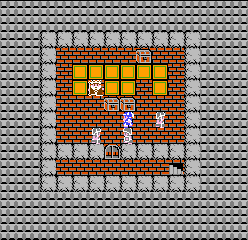
This classic scene could be recreated in minutes. First, the DM quickly designates the terrain type, caslte, and designates the floor spaces. Next, he places 3 NPCs defined only by their models, 3 chests, a door, and a staircase. He sets each chest, and optionally the door, to be opened by 'key 1' and could choose to either place their contents in ahead of time or drop them in during the game. From this point, there is nothing left to do but handle the role playing encounter during the game and to adjudicate any unexpected actions by the players.
The "Host a Campaign" menu will be largely similar to that of the adventure, save for having the additional functions necessary for longer term games. Key here is that, after the initial run, characters will sustain across sessions. Imagine playing a game of Little Big Planet, when someone gets a call. Rather than ending the game, the players may choose to collectively save and pick up right were they left later on.

And, finally, we have a couple of unspecific menus.

The "Community Created Content" menu will allow players to browse custom adventures, campaigns, and possibly other content created and uploaded by other players.

The "Options" menu is self explanatory.

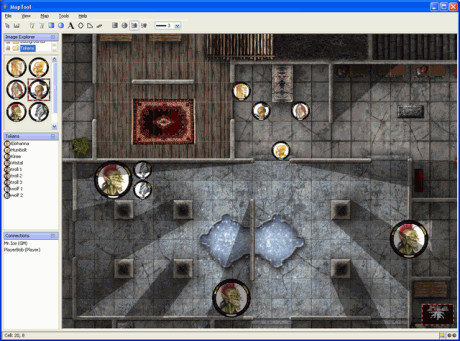
"Virtual Tabletop" programs, such as MapTool, pictured above, differ in that they are tools intended to facilitate the play of entirely separate games. This, however, would be its own, self contained title.
The game seems perfect for the XBox Live marketplace, and PSN if that were an option, for a few reasons. First, it is an essentially online experience. Without the social interaction, it is all but nonexistent. Thus, 100% of the game's potential audience has access to digital distribution. Second, it is an essentially niche title. It's new territory, and thus few publishers would be willing to risk a large investment on it. While proper execution could bring in a large audience of people who always wanted to try tabletop gaming but never had the opportunity, and a cult following could easily become a phenomenon, this does little to provide resources for the title's development. If anything, such success could lead to a full, disc release of a AAA sequel down the line.

So, thoughts?

Wednesday, November 10, 2010

Fatal Flaws: Short Instruction Manuals

Going forward, whenever I'm doing an article which highlights a weak design feature, but not a game as a whole, I'll be using the "Fatal Flaws" tag.

In this case, the subject of discussion is Call of Duty: Black Ops's instruction manual. I know, weird thing to be concerned about right? Hear me out though.

Black Ops's manual for the Xbox 360 is a total of 12 pages long. One of those pages is the cover art, the next is your standard seizure warning an ESRB info page, followed by the table of contents, then we have a page about connecting to XBox Live, another is a blank "notes" page, two pages are your standard "software license agreement" begging you not to pirate the game, and finally we have the back page which discusses customer support.That leaves us with a grand total of 4 pages actually providing instructions related to the game.


I was shocked by this lack of content. Then, I pulled out my copy of Modern Warfare 2. It has the same amount of pages, and is almost the same exact text.

While most people wouldn't make a big deal about the manual, as it isn't really part of the game, it seems a shame to me. First, I find that manuals are often indicators of quality in games. Guild Wars's manual is, for example, over a hundred pages, with half of that length discussing the game's setting and cultures. It really emphasizes the effort the design team had put into developing the context of the game and told me right away that this would not be the last title set in the world of Guild Wars. Blizzard tends to take similar steps, with Warcraft 3's containing a piece of short fiction telling the story of the ancient evils which once beset its world. The recent Call of Duty manuals, however, seem like afterthoughts. If so little thought was put into this aspect of the product, the user may think, where else where corners cut?

Second, I am dissapointed in that game manuals have, historically, been a part of the process for me. When I got a new game a kid, I would be absolutely ecstatic about bringing home a new game. I had days of amazing fun and wonder in that box, but it couldn't be released until the car ride was over. This anticipation resulted in me opening the case and reading the manual on the ride home. I would read every word, contemplate the significance of esoteric terms, as these were often JRPGs at this stage of my life, and carefully look over each peace of art. Before the disk ever hit the tray, the game had already started for me.

Recently, I experienced this ritual again with Halo: Reach. The delivery man came to my door right as I was leaving for work, so I didn't have time to pop the title in the Xbox for a quick game. On my way out the door, I stuffed the instruction manual in my pocket. Whenever I had a free moment at work, I would pull it out and tear through it. This was, again, a highly designed product. It had little in the way of fluff, but was covered in Halo flavor graphics and full of information. On the down side, however, I think there may have been a technical problem with this manual. Anywhere I touched smudged the ink. I tried washing and drying my hands, but the problem persisted. It seems that graphics on every inch of the page might have been an overuse of ink in this case - or Bungie simply used a low quality printing service.

I hate that, over time, the trend has become to focus less and less on game manuals. I hate that this ritual may be lost on future generations of eager gamers.

Tuesday, November 9, 2010

Popular Mechanics: Far Cry 2's Health System

As noted in the previous post, an old top 5 list I did for my college newspaper, I hated Far Cry 2. Now, part of that was due to my high expectations, but the fact remains that the game is inferior to its predecessor. In the video game industry, unlike in film, this is a rarity and an unforgivable one at that. That being said, there were good ideas in the title, good parts that never equaled a satisfactory whole. The most impressive of these, to me, was the health system.

In Far Cry 2, your health bar is similar to those you've seen before. It's a horizontal line that fills from the left. It's divided into segments, but that we have seen before as well. This, however, is what gives us the first notably unique aspect of Far Cry 2's health system. These segments represent a hybridized version of the now standard recharging health system, popularized by Halo, and the old school health pack method. After taking damage and finding a moment to rest, your health will not recharge fully but, rather, fill the current segment. This means the hero is never totally helpless, with at-least some sliver of health, but also provides long term punishment for recklessness. This balance works well, satisfying both the game designer's love for the elegant and self contained recharging health and that segment of the gamer community that feels recharging health too contrived.

What really makes this system, however, is the way in which players begin to regain that health. Rather than damage being treated as if the player is a water balloon, leaking HP through his bullet holes, Far Cry 2 tracks actual injuries. If you get shot, there is now a bullet lodged in you. If you fall, you have a broken leg. These things really improve the immersion felt by the player and seem to make each injury feel more serious, without ever actually changing the risk/reward dynamic.
This little piggy should have stayed home.

In order to regain health, the player must treat these individual injuries. This requires removing foreign projectiles, dislodging terrain on which you have been impaled, stitching up gaping lacerations, resetting bones, etc. This becomes a really pleasing mechanic for two reasons. First, the injuries are very viscerally pleasing. You see the end of your finger come out the opposite side of your arm when you push a through and through out. You see flesh burning as you cauderize an open wound. You hear the crack of bone. It's simultaneously disgusting and spectacular. For the more squeamish players, I can see this being more motivation to keep their heads down than the threat of death. Compounding this, however, is the sheer multitude of animations and variants to these injuries. Quite some time will pass before you see the same animation again, which prevents these injuries from ever seeming trivialized and really adds to the verisimilitude of the whole experience.

Still less painful, however, than the rest of the game.

All in all, this system is a big winner for me more because of its psychological aspects than its objective ones. It provides that super soldier level of endurance necessary for a game in which the protagonist is expected to fend off an army on his lonesome, but never really makes the player feel superhuman. These constant reminders of your mortality and how hard the fight has been go a long way to contextualize the combat.

While I've seen no game sense which has copied this system, I will note a vaguely related piece of design in the Halo franchise. As of Halo: Reach, the players health no longer regenerates along with their shields, recalling the original title. This promotes a bit more caution in the player, as though they have little health it can be the difference between going down in 5 shots or 6. I've often noted situations in which taking the time to grab a health pack has saved my life. While this might not have been directly inspired by Far Cry 2, and was likely done more as an effort to return the series to its roots and maintain chronological canon, it does show an increasing popularity in this hybridized method.

Outdated Game Reviews: Halo 3

Halo 3 Shines, Even by PC Standards

     Bungie Studios' "Halo 3" came out Dec. 25, and instantly became a must-have game for the XBOX 360. "Halo 3" improves on the formula on many points, and finally matches the kind of shooters seen on the PC.
    The original "Halo," like "Goldeneye" before it, provided an entertaining social outlet in the form of a well-designed multiplayer console shooter. However, repetitive game-play and an unoriginal plot plagued the single player campaign. The single player took a backseat to the multiplayer game, and this trend has continued.
    In the single player campaign of "Halo 3," the player made constant progress through ever changing locals on their way to the final destination. This and the memorable set-piece battles dispersed throughout the campaign put an end to any feelings of repetitiveness and gave the game some epic action sequences that rival anything else on the market.
    The story, however, was still lacking. The player again takes control of a poorly characterized super soldier cliché fighting against alien clichés. Master Chief is Samus Aran, the "Doom" guy the "Quake" guy the "Marathon" guy a Terran or any of a long lineage of space-marines.
    The flood were essentially the "Starcraft" Zerg, right down to their species assimilating nature, hive-mind leader and even their sound effects. The Zerg themselves where derivative of the "Warhammer 40,000" Tyranids, which were derivative of "Alien", and they where all derivative of Robert A. Heinlein's "Starship Troopers."
    Games like "Half-Life 2," "System Shock 2" and "Bioshock" are forcing the market to produce shooters with well-written plots, deep characters, and quality acting to match their gunplay. While Cortana, the Arbiter and Sgt. Johnson receive competent actors, and the plot is definitely complex, it is simply not as well written or emotionally engaging as other titles.
    Halo has, since its original release, been the best deathmatch style game on any console. I qualify that statement because most PC gamers found "Halo" unimpressive. While console gamers had been limited to split-screen play before the previous generation of consoles, PC games were able to take advantage of online-play since 1993, resulting in several series including "Doom," "Quake" "Tribes" and "Unreal Tournament," all of which had done everything Halo had before and, arguably, better.
    "Halo 3" changed this by increasing the scale and depth of the game-play in both the single-player and multiplayer. Bungie added large maps rivaling those of "Unreal Tournament 2004." They also balanced the weapons to near perfection. These improvements, amongst others, made "Halo 3" the best deathmatch style multiplayer game out.
    It may not be the best multiplayer shooter on the market though, as class-based and tactical shooters have had very good releases recently. "Team Fortress 2", and the upcoming "Unreal Tournament 3" and "Call of Duty 4" are going to be tough competition.
    Epic Games'" Unreal Tournament 3" appears to be the greatest threat to "Halo 3". Epic games had great success with "Gears of War" on the XBOX 360, and with "UT3" they seem to want to correct their previous mistakes on the console market. The PC's premier deathmatch-style game is due out on the 19th, and the PS3 and XBOX 360 versions are coming soon after. Look forward to my review of "UT3" to see how the two stack up.

Wednesday, August 25, 2010

Featured Feature: Player Investment (Part 2)

Part 2: The Top Tier Problem

So, we've talked about what exactly "player investment rewards" are. Now, we're going to get into some of the current problems with prominent implementations of the feature. In this case, we're going to focus on rewards that aren't merely commendations, but rather tangible benefits within the game - ie: equipment and abilities.

In short, rewards designed to be the absolute best in their class pit players’ desire for uniqueness against their desire to accomplish and have their accomplishments recognized. This discourages customization for some and achievement for others. A title’s degree of variety and individual expression online is directly proportional to the number of equally valued customization options provided to players.

Prominent examples of this problem include
Halo 3’s "hayabusa" & "recon" helmets, Modern Warfare’s weapon camouflage, and World of Warcraft's equipment.

Halo 3, for example, features 11 online armor variants available to most players. These variants are designed to provide players with a sense of individuality as they mix and match them, color them, and otherwise use them to form a unique persona online. Theoretically, this emphasis on individuality and the wide variety of tastes amongst the player base should result in a fairly even distribution of armor variants throughout the community.

This is, however, not the case. The “recon” and “hayabusa” variants, especially their helmets, seem to be far more common amongst those players who have unlocked them. The same is true of the other armor variants to degrees in direct proportion to the amount of work necessary to unlock them.This presents a problem, as the variety and individuality intended by the developer has been overshadowed by a second well intentioned feature, player investment rewards.


If you can look like this, you won't not.

The same problem can be seen in many other titles, most notably those which make heavy use of such player investment rewards. World of Warcraft, for example, features thousands of weapons, but only a very small fraction of those are actually desired by its most committed players. When new and better items are introduced, they do not increase variety but rather replace others as the now most desirable "top tier" options. Players invest a great deal of time in order to receive these rewards, only to be forced to sacrifice their avatar’s individuality for the ability to display them.


High level mages, or roving Warriors style street gang?

This problem is compounded by the fact that when a large portion of players display the same rewards, desiring recognition for their achievements, they, in fact, become less recognizable amongst the crowd of similarly outfitted characters. Thus, some may choose to forgo such challenges all together, knowing that they will not wish to display their rewards. Allowing the majority of the developer’s efforts to fall into such disuse seems not only to be contrary to the original design intent, but to also be poor financial investment.


These choices soon to be rendered moot by 200lbs of phat purple loot.

Solutions

The simplest solution to this problem might seem to be the elimination of “top tier” rewards all together. This, however, inherently depreciates their value as player investment rewards.

A better solution, it seems, is to eliminate the singular nature of the highest tier options. The Halo 3 armor variants, for example, might have been unlocked via multiple separate but equal progressions. Some armor variants might be unlocked by campaign player progress and achievements, while others would be unlocked by multi-player progress and achievements. This would result in two top tier armor variants, doubling variety while both equally rewarding player investment and providing more opportunities for such investment. A form of this strategy can be seen in World of Warcraft, in which players may gain the game’s highest tier armors either from raids or arena combat. These two alternative paths provide equal statistical reward to players who choose either rout, yet also present aesthetic differences from one another. Thus, players are able to feel as if they are displaying their prowess, while not necessarily becoming identical. Further, the more specific nature of these rewards more accurately portrays the nature of the player’s excellence.

Another option, and one which can be combined with other solutions, is to provide variety within a single reward. Halo 3’s armor system does, for example, allow players to mix and match amongst their armor variants and choose a unique color scheme. Thus, two individuals may have very different character models, despite sharing the same helmet. The problem this raises, however, is that the head, and face more specifically, is a physical feature very closely linked to identity. There is a biological tendency to notice a person’s face before examining them as a whole which extends to online avatars. Even if two character models are different in every other way, similar faces, or helmets in the case of Halo 3, can reduce the sense of variety. Variety could be added to individual helmets, however, by allowing players to further customize the helmet. This could include multiple visor colors, textures, the ability to choose glossy or matte finishes, smaller accessories such as antennae or eye pieces, what have you. In Modern Warfare, players could be rewarded not with “Red Tiger” and “Blue Tiger” camouflage, but with “Tiger” camouflage which they could set the tint of as they wish. Simply put, granularity increases variety.

If you enjoyed this post, please subscribe!

Tuesday, August 24, 2010

Featured Feature: Player Investment (Part 1)

Part 1: The what and why of Player Investment Rewards

As the blog goes on, I’ll be establishing various ongoing features. Individual game analysis, developer profiles, etc. in some regular format. We’ll begin with a “Featured Feature,” in each entry of which I will analyze a particular game mechanic, its history, place in the industry, how it works, why it works, what’s wrong with it, how it can be better utilized, etc.
Over the next few days, we’ll be focusing in Player Investment.


Lately players may have noticed a trend towards greater degrees of character customization in their online games. Halo, Call of Duty, Battlefield, they’re all doing it. In the past it was the standard that all players began games as complete equals, with an even and thus fair footing. Now the emphasis has been placed, instead, on individuality and deep character customization. So deep has this gotten in some games that is borders on being considered an RPG element.
What players might not have discerned, however, is the cause of this trend. While it is easy enough to simply wright it off as stolen ideas, arguing that developers are simply trying to duplicate the success generated by either Halo’s visual customization or Modern Warfare’s tactical customization, this is an oversimplification. In truth, such features are a very wise business decision.

You see, these character customization options almost always have another common feature. Rarely are all of these options available to every player immediately. They are generally unclockables, options requiring the completion of some predetermined qualification before access to them may be granted. This effectively makes these customization options merely a small part of the industry’s larger trend towards rewarding player investment.

Player investment reward systems provide players with benefits in direct proportion to the time and effort they spend with the game. The simplest form of these can be seen in the MMMORPG genre, in which players gain quantified levels of power as they put more time into the game. The term “experience points” was originally intended to reflect an abstract measurement of a character’s life experience and earned knowledge. In this market, however, it could as easily be seen as an absolute measurement of the amount of investment a player has put into a particular title. It is no mistake, then, that even more complex player investment reward systems, such as those seen in Halo 3 and Modern Warfare, still retain the term “levels” and “xp.” They firmly establish a system of progression in terms which gamers know.
This sense of progress lies at the heart of any player investment system. Rewards be they new character model options, abilities, or even simple numerical values are not handed out in bulk. They are evenly distributed over a long trail, always giving the player one more reward to work for. This creates a “carrot on a stick” scenario, compelling the player to continue playing. Progress requires commitment.

Such strategies simply make good business sense. The MMO genre, again, provides the simplest form of this. Due to subscription fees, the longer a player plays, the more money the developer will earn from them. In non-subscription based genres, however, developers still reap great benefits from invested players.

Online games, for example, are particularly dependent player investment. on the existence of an online community to function. Many games with some simple, tacked on multiplayer component soon have this feature rendered essentially non-existent by the fact that there are simply not enough players available to reliably establish game lobbies. By encouraging player investment, however, a developer encourages players to return time and again to the same matchmaking system, populating their multiplayer lobbies.

Beyond simply providing functionality, however, a well executed player investment system has been shown to increase the overall sustained population of online communities. This is desirable as more people playing more regularly is good for the bottom line. It provides a title with a good reputation and a greater likelihood that any given consumer will purchase the title. “Surely thousands of gamers can’t be wrong,” thinks the consumer. Every time your game is ranked on the top X most played online games on console Y during time period Z, that’s free advertisement. Most importantly, every player committed to your title is another mouth to spread the word. If they play your game for a week, you get word of mouth for a week. If they play it for a year, they’ll sell everyone they know on it.

On the marketing side, player investment can help provide a title with market control. It can help you not only be successful, but WIN. It's not secret that Modern Warfare and World of Warcraft are huge right now, enormous market titans with incredible player bases. What you might hear less about, however, is that they've done so well they've hurt other company's bottom lines. Many people are playing these games with such devotion that they simply do not have much time for other games. It is, for more time than is conventional, enough game for them. While this doesn't particularly help a non-subscription based game, it's a tremendous benefit for a series. A large portion Modern Warfare 2's success can be attributed to the fact that there was a large audience of Modern Warfare 1 players who had never stopped regularly playing the previous game, and the same will be true for Black Ops (though I'm skeptical of the series' continued dominance post-Infinity Ward debacle). The series did not leave its competitors any room to scoop up members of its player base, giving the sequel very little competition. It's not the nicest marketing strategy, but it moves units - short term and long.

Player investment works on even the most basic level. These systems actually make games seem more valuable to players. Biologically, human beings are predisposed to an "escalation of commitment," meaning that the more resources you spend on something, the more valuable you think it is. If you've spent several years in your house, for example, thousands of dollars on bills and upkeep and it catches on fire - you will likely be stuck in a conundrum. Even though it may be cheaper to move, buy a new house in a different location with the same features as your old house, your brain may compel you to spend more money on repairing your old house anyway. The $59.99 initial price tag, the hours of invested time, and any associated fees or accessories all build up to make the player value their investment more and more each day.

Don't be confused or frightened though. While all of these issues are from a developers perspective, they are by no means bad for players. The escalation of commitment, for example, contributes to a player's enjoyment of the game. The more they play, the more they like what they're playing. Player investment rewards can really drive a gameplay experience, keeping a game fresh long after it's no longer new.

That being said, however, no current implemented player investment strategies are perfect. Over the next few days I'll be going over some key problems with the most prominent such strategies, and ways in which they could be improved for the benefit of both developers and gamers.
If you enjoyed this post, please subscribe!