Wednesday, February 16, 2011

Featured Feature: Player Investment in Casual Games (Part 1)

 Part 1: Player Investment in the Short Term

So, earlier today while fooling around with Unity 3D, more on that later, and looking for a solution to one of my problems in my current project I stumbled upon someone else's support thread. The query is irrelevant, but regardless I tried to help by playing the demo of the game he'd been working on, Chuck the Adventure Duck. It's a fun little platformer with some unique elements, but that's not really what sparked the post. That was the initial responses to his advertisement of this demo build.

Therein another poster mentioned allowing his young daughter to try the game. She instinctively reached for the spacebar to jump and, failing this, quickly grew frustrated with the game's use of the "up arrow" for jumping.

Now, obviously the solution for such frustrations is to map redundant controls. There's really no reason not to map Jump to Up, W, and spacebar, as well as putting Left, Down, and Up on A,S, and D respectively. The thing that got me thinking, however, was how quickly such a simple and inconsequential thing turned her off of the game.

Earlier in the blog I'd made a few posts about "Player Investment Strategies" (1, 2, 3). These really focused either on the concept as a whole or its application to large AAA titles. I addressed the macro, but never really the micro.

While Player Investment is key to the long term retention of customers for more drawn out games, one may assume that it isn't an issue for "casual games." Games played on web browsers or mobile devices are, after all, not expected to be played in more than short bursts. It is, however, this temporal aspect of the player's experience which makes attention to "player investment" absolutely crucial. The player will only be exposed to the game for a few fleeting minutes and, without such care, it is entirely possible that those will be the only minutes in which they will ever experience the title.

Unlike more traditional PC or console games, most "casual" games do not require any initial investment. Most people's first exposure to Angry Birds or Words With Friends, for example, is likely not even on their own system, but over the shoulder of a friend.
I love that the iPad has basically revived "hot-seat" play. I'd like to think these kids are playing Heroes of Might and Magic III.
You may recall our previous discussions in which I mentioned that the human mind, in its fantastic imperfection, has a tendency to overvalue things in which it has invested. The very fact, then, that a AAA title has already cost the consumer ~$60 makes them more likely to feel that it is a good game. The alternative, after all, is to admit that they have made a foolish decision. Ever gone on a shopping spree and picked up a sackful of games on the cheap? Your experience with any one of those is never quite like it is when your only able to bring home only one title, is it?
There are very few games I wouldn't pay $5.00 for. Many of them are on the Wii.
It is this lack of bias the casual game creator must overcome. Their title is new. The likely lack of promotional fanfare has left the consumer devoid of preconceived notions. They have no initial investment, and thus lose nothing if they drop the title after seconds. This is exactly why those first few seconds are so important.

So how, then, do you consciously design your title to build such investment? It comes in two steps: removing the initial "barrier to investment" and providing "rapid escalation of investment."

That being said, I want to discuss two specific aspects of game design and I can already tell that this post is getting too long. So, we're going to break this up into another 3 parter. Stay tuned for "Part 2: Removing Barriers to Player Investment," and "Part 3: Escalating Player Investment" over the next couple of days.

Monday, January 24, 2011

Sequelitis: Fable 3

So, a while back I made a post about Fable 2, discussing how I believed the sequel has developed the original games ideas and how I think the series should move forward. Well, Fable 3 is actually out now, so let's look at what's occurred.

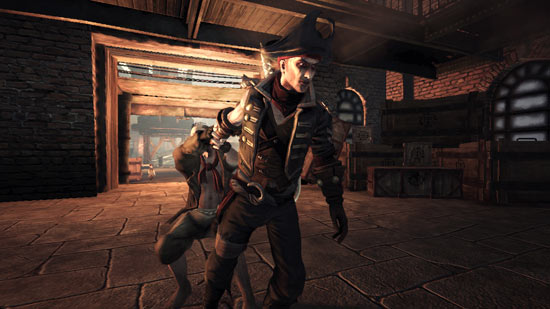
Image used for no reason other than that my hero looks exactly like that guy. With a sweet witch-hunter hat, of course.
Now, while this won't be a review, I should start by providing a general assessment of the game's quality, if only to contextualize the arguments herein. I enjoyed the game. I didn't feel it was overly short as, taking my time to take advantage of all of the content the game had to offer, it actually took me longer to be done with Fable 3 than Fable 2. The core storyline missions may possibly be shorter, but I got more hours of fun out of it than its predecessor. That being said, I still wrung it dry in less than a week, so I recommend it, but only as a rental or, as was my case, a borrow. I've heard a lot of people I normally agree with decry it as being absolutely horrible, but most arguments I've heard tend to be very nit-picky, focusing on a few things they hated. In a Peter Molyneux game, however, one must realize that he's going to throw a lot of stuff at the wall and, though not everything sticks, you're getting more experimentation in a title than you're gonna get in almost any other AAA title.

To start with the good, Fable 3 finally begins to do what Peter Molyneux has been promising it would from the very start. You actually do have a noticeable affect on your world that has started to move beyond the token and into something of actual consequence. Rather than the pair of binary choices presented in the previous game, there are many ways in which I may make my Albion different from yours. I may or may not have a chicken racing track, Albion lake, a brothel or an orphanage, a ruined or well kept city, an inspiring castle or black fortress, a thriving metropolis or deserted ghost kingdom, etc. In the end it just boils down to more multiple choice options, but the far higher number has begun to leave enough variables to have interesting results.

More importantly, these decisions are now tied into the actual game-play and narrative. Ones actions may now have unintended consequences. This, moving forward, should be an essential element in developing player influenced worlds. Without accidents, the world would be a much more banal place. I, for one, did not intend to become Albion's beloved and benevolent murderer king, but that's what happens when your gun accidentally goes off in a crowded market. So much the better.

Why can't I both renovate the orphanage AND build a brothel? I like babies and boobies. Is that so strange?
This being said, this mechanic still suffers from unnecessarily moralistic mechanics. There is absolutely no subjectivity to the game's decisions, to the point that you are always explicitly provided with both an objective moral assessment of the available choices and their certain results. You will never regret a mistake because, unlike the real world, everything is an absolutely known quantity.

The same issue leaks into the confusingly simplified NPC interactions, wherin you can simply tap Right Trigger to know every character's life story and you always know exactly how anyone will react to any given interaction.

In comparison, the most effective piece of game design in the oft panned Prey was a sequence early in the game involving a rather nasty machine, seen in the below video (not my own).


Basically, it's a conveyor belt of death ending in overkill via impaling. Impractical, but impressive. During this introductory sequence, the player gets off of the "conveyor belt" and is attempting to free the others, including his grandfather and lady-friend. During this process, the player does manage to stop the device. Then this happens (again, video not my own):


The player, passing through yet another alien hallway, spots a button facing the machine. Due to human curiosity and years of video game conditioning they, in all likelihood, press it. I know I did. The machine is reactivated and the player watches as his grandfather dies. You have jumped without looking, made a mortally serious mistake, and one which you have absolutely no hope of recovering from. Now, I could be wrong on some specifics here. Maybe the game does force you to press the button to continue. Maybe the game entirely ignores this wonderful moment of drama from there out. I wouldn't know. It is, however, irrelevant. All that matters is the impression that this perceived decision makes upon the player. The voice actor need not even say it. "What have I done‽"

Fable 3, to return to our subject, explicitly denies the players any chance of such revelatory moments, either for good or ill, and thus denies them a chance at emotional connection with the game.


The other issue here is that, much like the previous title, this approach limits replayability. As the player already knows what the alternative would have been, they have little motivation to spend another day of their life to see it actually play out. There is also no real variety, as the vast majority of players will, due to the game's binary morality system, choose either all of the good or evil options, meaning that of all the possible combinations, only 2 will really be seen online. This approach has limited the game's variety, when I lighter touch would have effectively multiplied the content on the disc without actually having to produce any more.


As I'd feared, Molyneux has also dabbled a little too much in novel concepts which haven't really come to much. Before release, for example, he made a huge deal out of the new hand holding mechanic, claiming that it delivered a great emotional connection to the NPCs. Not only does it not, but the mechanic doesn't even work. You constantly loose your grip on the NPCs, and a person being dragged off too jail, a buddy being led home after a long night of drinks, and a bashful first date all act exactly the same when the mechanic comes into play. The obvious goal was to capture a little of the drama of Ico, but it was a gimmicky waste of time here.
Bullshit
What "dragging" a criminal to prison actually looks like.
-Set to "Happy Together" by the Turtles
Overall, I'd say the game was an improvement over its predecessor but, in trying to streamline some mechanics, the dev team accidentally oversimplified some. Simplicity is a worthy goal, but not at the cost of depth. There is a balance there which, hopefully, the eventual sequel will be able to strike.


What I want to see in Fable 4:
- Moral ambiguity. Mass Effect's "Superman" vs "The Punisher" morality system not only makes more sense within the pre-set hero narrative, but is far more compelling.
- Better weigh simplicity vs depth. I found the NPC interactions and melee combat to be a bit watered down from the previous installment, but could not think of a single way in which these had improved the title.
- NPCs, beyond the supporting caste, that do not seem like mindless automatons. The constant encouragement to emotionally invest in, marry, and have children with these NPCs seems outright creepy to me at this point. In this area, the Fable series has achieved an uncanny valley, not of anatomy, but of persona. The Sims, for example, do at-least seem like simplistic caricatures of human personalities.
- Don't have the game constantly tell me to buy DLC. Hearing John Cleese shill for premium dye colors was down right pathetic.
- Don't charge for DLC, such as dye colors and varying dog breeds, which seem like fixes to glaring problems with the original release.
- Keep the interactive "menu" system. It's gotten a bit of guff due to its imperfections, but it's a solid step forward that should be embraced as a stroke of genius game design.
- Keep building on Albion as a growing place while showing us older parts we remember. Maybe even steal some Mass Effect 2 style cross-game influence. It really helps unify the series.

Games I Want to Make: Console Based "Tabletop" RPG (Part 2: Essence)

Of course, the idea as presented in the previous post does seem somewhat complex. As people in the comments have indicated, RPGs are possibly the most complex genre of game to develop, due to the demand for deep systems. If you're going to show the player your work, after all, you have to ensure that that work is thorough. Otherwise, they're just pulling back the curtain to see that Oz is an old lost guy.

So, let's take a step back. It occurs to me that it doesn't seem I've properly communicated the essence of the idea. I've also probably bogged myself down in unnecessarily clutter. Forgive me. Let's get back down to the essential and do away with confusing window dressing.

In short: This concept represents a Role Playing Game, literally. Not an "RPG" in the sense of the genre standard, of rolled dice and +X to STR. I have absolutely no desire to produce a D&D game because, for one, I don't think adapting those rules to a different context is a very effective or worthwhile goal. The benefit of a video game, over table top, is the ability to work in real time.

So, what would the game look like?

Well, from the player's perspective, an action game. Running around from a top down perspective, slashing enemies, exploring dungeons, would have much more in common with Zelda, Pixel, or Gauntlet than D&D. If the characters are choosing from "Wizard," "Warrior," etc. then there may not even be any necessity to customize your characters stats, especially not in any early prototype of such a game.

So, how the hell is that an RPG, or a "Virtual Tabletop?"

Because it is an avenue to Roleplaying. IE: A person taking on a character and interacting with the guy running the game and his fellow players on a complete subjective level.

And there, I believe, is where I have failed to communicate properly. This origin of this idea was in its simplicity. I can run a traditional roleplaying game without any accessories. No books, no dice, no character sheets, just a group of friends. They tell me who they are pretending to be, I describe a scenario, and they react. That is an RPG. Everything else is just a tool to aid in establishing that scenario.

And how would such a game do this? By not getting in the way. Such a game should be a toolset, much like Minecraft or Garry's mod in that it doesn't really represent a game in and of itself. All you need is character models, a toolset for the person running to game to create a rudimentary play-space and populate it, and a simple interaction system for the players that removes the burden of traditional RPG rules from the host.

Monday, November 22, 2010

Games I Want to Make: Console Based "Tabletop" RPG (Part 1: Concept)

It has been argued that the modern internet exists for one reason: nerds wanted to use their computers to play Dungeons & Dragons. Since message boards and chat rooms have existed, they have been used to play D&D. MMORPGs descended from MUDs which descended from text based adventure games, the last of which also spawned the modern CRPG and allowed the PC to stand as a gaming platform before the era of GUIs.

Yet, for all these attempts at simulating the D&D experience, few have come close. The majority have focused on single-player narratives which, as fun as some of these are, seems to entirely miss the appeal of the tabletop genre. How many of you have played D&D or any other tabletop RPG? How many have played these games alone? Almost none, right? The vast majority of these games' appeal comes from their social nature.

The closest any game has come to capturing this experience, so far, has been the original Neverwinter Nights. Ironically, this essentially D&D game's attempt is imperfect, in my opinion, because it sticks to closely to its pen and paper roots. Instead of taking the experience and adapting it into a digital medium, it makes a literal translation of the source material. There has yet to be a title that utilizes interactive media to its full advantage in creating this style of game.

Neverwinter Nights' Aurora toolset remains somewhat notoriously esoteric. This would be a title designed for simplicity, providing as much depth as possible without necessitating a complicated adventure editor.

Thus, one of the game concepts I've been playing around with for a long time is one of a console based RPG done in a "tabletop" style. That is to say a CRPG that plays like Dungeons & Dragons, WFRP, etc. While I have a prototype of such a title as a work in progress, it's quite far from any publishable state. But what would such a title entail?

Well, for illustrative purposes, let's have a look at a possible menu tree:

Adventurer
  • -Solo Campaign
  • -Load Solo Adventure
  • -Find an Adventure
  • -Find a Campaign
Dungeon Master
  • Adventure Editor
  • Campaign Editor
  • Host an Adventure
  • Host a Campaign
Community Created Content
  • Adventures
  • Campaigns
Options

(edit:  There was some confusion, but the intent here was to imply nested menu options, going from one screen to another. The list has been reformatted to reflect this better. Thanks NINJ4KYL3.)

So, what he have here shows the gist of the game. What we have is a title that allows users to take on one of two active roles, that of an "adventurer" or a "dungeon master." The former's role is that of the traditional player character, while the latter is that of a host, amateur designer, and nemesis to the players. This is the essential element of the tabletop game.

As the adventurer's role is the easiest, we'll take a quick look at that first before getting into more detail in another post. The options under this menu include playing the game's default solo campaign, loading a custom adventure they have downloaded, or seeking out either a short term adventure or long term campaign online. It becomes important, here, to define the terms "adventure" and "campaign." An "adventure" is a relatively short, single session, self contained quest. A level, basically, akin in scale to what one might design for Little Big Planet. A "campaign" is a larger set of linked adventures, with characters and rules that persist across adventurers and game sessions. An adventure is basically a pick up and play scenario, where a campaign will be designed for a single host to run a long term game for a constant group of players, possibly over the course of many game sessions. (More on this later)

The game's built-in solo campaign would be relatively short, simple, and archetypal,  intended primarily to introduce new players to the game's mechanics and to provide a modicum of offline utility to the title. In this, the player would be able to choose a single one of the player classes and play through a rather traditional little RPG storyline on their own.

The "Load Solo Adventure" menu would lead to a menu allowing the player to load any of a number of community created solo adventures made by themselves or others from the Dungeon Master menu.

The "Find Adventure" menu would lead a player to a familiar game lobby browser, wherein they can browse and enter a multiplayer adventure lobby hosted by another player. From the browser, the player may be able to see information such as the adventure and lobby name, host, number of players, number of players requested, and the average rating of the adventure. Essentially, it should appear to be a combination of a multiplayer game browser and a custom content browser. Once in a unique lobby, the players and host will be able to converse via microphone or text chat and choose their characters.

The "Find Campaign" menu would lead a player to a similar lobby, wherein they can browse and enter a multiplayer Campaign lobby hosted by another player. This would be differ from the above in that campaigns would have somewhat differing descriptions, and that campaigns in progress would only become visible to players already involved in those campaigns. Xbox Live functionality (I have no realistic means of publishing on PSN) will likely play a large role in this aspect of the game, as it is both essential for voice communication and likely how most recurring campaign lobbies will be populated.

For Dungeon Mastering, we have a somewhat more varying set of menus.

The "Adventure Editor" is where a great deal of the Game Mastering gameplay will take place. This will function as a traditional grid-based map editor, where the player can design the adventure's terrain, place decor, and NPCs. The game will take place from a top-down perspective, with grid based construction. This will allow the player to construct entirely standalone games, allowing non-hosted play. (More on this in its own post, as this is really the heart of the experience.)

The "Campaign Editor" allows a player to compile multiple adventures into a single campaign and define the properties of that campaign.

The "Host an Adventure" menu allows the player to do just that. The host, or "Dungeon Master," does not remain complacent, however, as he retains the full breadth of his editorial power as the game takes place. He may drop in new enemies in for an ambush; manipulate, even kill, characters and terrain instantly as the narrative demands, rather than the literal on-screen actions of the players; reveal hidden passages, etc. at will. He may even choose to construct the adventure as the players go. If the DM likes, he may save such changes at the end of the game. Think Halo's "Forge." Furthermore, he may choose to fully take on the traditional role of the DM, narrating, roleplaying NPCs, and engaging the players in roleplay. It remains the hosts choice weather he runs a silent hack-n-slash Gauntlet style game, a session of deep role-play, or a little of both.
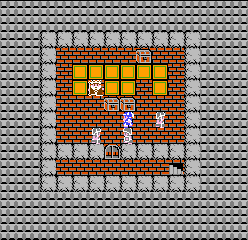
This classic scene could be recreated in minutes. First, the DM quickly designates the terrain type, caslte, and designates the floor spaces. Next, he places 3 NPCs defined only by their models, 3 chests, a door, and a staircase. He sets each chest, and optionally the door, to be opened by 'key 1' and could choose to either place their contents in ahead of time or drop them in during the game. From this point, there is nothing left to do but handle the role playing encounter during the game and to adjudicate any unexpected actions by the players.
The "Host a Campaign" menu will be largely similar to that of the adventure, save for having the additional functions necessary for longer term games. Key here is that, after the initial run, characters will sustain across sessions. Imagine playing a game of Little Big Planet, when someone gets a call. Rather than ending the game, the players may choose to collectively save and pick up right were they left later on.

And, finally, we have a couple of unspecific menus.

The "Community Created Content" menu will allow players to browse custom adventures, campaigns, and possibly other content created and uploaded by other players.

The "Options" menu is self explanatory.

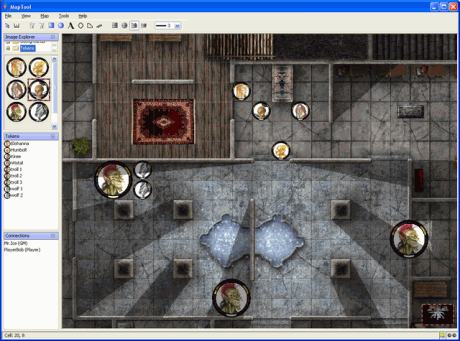
"Virtual Tabletop" programs, such as MapTool, pictured above, differ in that they are tools intended to facilitate the play of entirely separate games. This, however, would be its own, self contained title.
The game seems perfect for the XBox Live marketplace, and PSN if that were an option, for a few reasons. First, it is an essentially online experience. Without the social interaction, it is all but nonexistent. Thus, 100% of the game's potential audience has access to digital distribution. Second, it is an essentially niche title. It's new territory, and thus few publishers would be willing to risk a large investment on it. While proper execution could bring in a large audience of people who always wanted to try tabletop gaming but never had the opportunity, and a cult following could easily become a phenomenon, this does little to provide resources for the title's development. If anything, such success could lead to a full, disc release of a AAA sequel down the line.

So, thoughts?

Saturday, November 13, 2010

Faery: Indie Game Failure

So, I;m sitting in a room full of friends, myself and three others, playing this game I downloaded off of Xbox Live. Faery it's called. Unfortunately, we can't tell head from tails on this thing. It's one of those games that tries to be so original it fails at ever successfully capturing anything playable. What, I ask, is its audience?

That isn't to say that somewhat eschewed mechanics are necessarily bad. Some games are built on the basic concept that figuring out the gameplay IS the gameplay. When done well, this can be quite fun. It is, however, an extremely difficult trick to pull off. A good designer knows not to intentionally confuse their audience without a very good reason. That is not what Faery presents us with. Faery is merely incomprehensible.
Hey,cool! Wish I'd seen this in the demo.
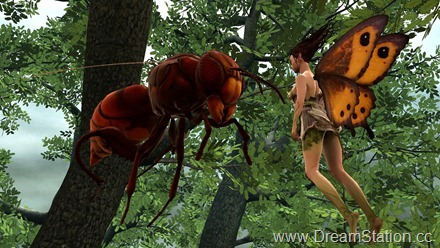
The game does, it seems, present a fairly accurate depiction of faeries via Germanic folklore. The controls and the players goals are incredibly esoteric and strange. We want very badly to break into this game. We want very hard to "get" it. We understand that, behind all of this effort, there is a designer. There is a man. This man has the intent of bringing an enjoyable experience to the end user. However, we simply can not reach this experience. Perhaps there is some fundamental importance to this product. Perhaps this is one of the most breathtaking experiences yet to be visited upon the direct-to-console market. Yet, we can not successfully penetrate it. I see this as a failing upon the designer. Yet, I welcome any commentary he may have.
Romantic subplot? Bow chika bow wow!
This is one of those games that strikes me as some indie films do. They are so completely hard to comprehend, despite my desire to do so, that I am left with nothing more than a dismayed critic's resolve to present a rational opinion. It is a game. That is a fact - no, a possibility. I have yet to confirm this. That, it would seem, is the problem. I can not tell that this is a game. I can not confirm that this is in interactive entertainment experience. This may be a problem.
I cast lens flare!
I don;t know. I like the idea of the Xbox Live Marketplace. I like the idea of indie games. When one shows up that seems so incomprehensible, however,  I sometimes find myself thankful for the draconian policies of software publishers.

This game is a good lesson for indie devs. Do you have something brilliant? Is it amazing?
Is it the most fantastic thing ever to visit the gamescape©? (new word, free for public yet nonprofit use) Awesome! Does it make any sense? Damn. Back to the drawing board I guess. One must always be cautious not to allow vision to outpace ability.

Wednesday, November 10, 2010

Fatal Flaws: Short Instruction Manuals

Going forward, whenever I'm doing an article which highlights a weak design feature, but not a game as a whole, I'll be using the "Fatal Flaws" tag.

In this case, the subject of discussion is Call of Duty: Black Ops's instruction manual. I know, weird thing to be concerned about right? Hear me out though.

Black Ops's manual for the Xbox 360 is a total of 12 pages long. One of those pages is the cover art, the next is your standard seizure warning an ESRB info page, followed by the table of contents, then we have a page about connecting to XBox Live, another is a blank "notes" page, two pages are your standard "software license agreement" begging you not to pirate the game, and finally we have the back page which discusses customer support.That leaves us with a grand total of 4 pages actually providing instructions related to the game.


I was shocked by this lack of content. Then, I pulled out my copy of Modern Warfare 2. It has the same amount of pages, and is almost the same exact text.

While most people wouldn't make a big deal about the manual, as it isn't really part of the game, it seems a shame to me. First, I find that manuals are often indicators of quality in games. Guild Wars's manual is, for example, over a hundred pages, with half of that length discussing the game's setting and cultures. It really emphasizes the effort the design team had put into developing the context of the game and told me right away that this would not be the last title set in the world of Guild Wars. Blizzard tends to take similar steps, with Warcraft 3's containing a piece of short fiction telling the story of the ancient evils which once beset its world. The recent Call of Duty manuals, however, seem like afterthoughts. If so little thought was put into this aspect of the product, the user may think, where else where corners cut?

Second, I am dissapointed in that game manuals have, historically, been a part of the process for me. When I got a new game a kid, I would be absolutely ecstatic about bringing home a new game. I had days of amazing fun and wonder in that box, but it couldn't be released until the car ride was over. This anticipation resulted in me opening the case and reading the manual on the ride home. I would read every word, contemplate the significance of esoteric terms, as these were often JRPGs at this stage of my life, and carefully look over each peace of art. Before the disk ever hit the tray, the game had already started for me.

Recently, I experienced this ritual again with Halo: Reach. The delivery man came to my door right as I was leaving for work, so I didn't have time to pop the title in the Xbox for a quick game. On my way out the door, I stuffed the instruction manual in my pocket. Whenever I had a free moment at work, I would pull it out and tear through it. This was, again, a highly designed product. It had little in the way of fluff, but was covered in Halo flavor graphics and full of information. On the down side, however, I think there may have been a technical problem with this manual. Anywhere I touched smudged the ink. I tried washing and drying my hands, but the problem persisted. It seems that graphics on every inch of the page might have been an overuse of ink in this case - or Bungie simply used a low quality printing service.

I hate that, over time, the trend has become to focus less and less on game manuals. I hate that this ritual may be lost on future generations of eager gamers.

Tuesday, November 9, 2010

Popular Mechanics: Far Cry 2's Health System

As noted in the previous post, an old top 5 list I did for my college newspaper, I hated Far Cry 2. Now, part of that was due to my high expectations, but the fact remains that the game is inferior to its predecessor. In the video game industry, unlike in film, this is a rarity and an unforgivable one at that. That being said, there were good ideas in the title, good parts that never equaled a satisfactory whole. The most impressive of these, to me, was the health system.

In Far Cry 2, your health bar is similar to those you've seen before. It's a horizontal line that fills from the left. It's divided into segments, but that we have seen before as well. This, however, is what gives us the first notably unique aspect of Far Cry 2's health system. These segments represent a hybridized version of the now standard recharging health system, popularized by Halo, and the old school health pack method. After taking damage and finding a moment to rest, your health will not recharge fully but, rather, fill the current segment. This means the hero is never totally helpless, with at-least some sliver of health, but also provides long term punishment for recklessness. This balance works well, satisfying both the game designer's love for the elegant and self contained recharging health and that segment of the gamer community that feels recharging health too contrived.

What really makes this system, however, is the way in which players begin to regain that health. Rather than damage being treated as if the player is a water balloon, leaking HP through his bullet holes, Far Cry 2 tracks actual injuries. If you get shot, there is now a bullet lodged in you. If you fall, you have a broken leg. These things really improve the immersion felt by the player and seem to make each injury feel more serious, without ever actually changing the risk/reward dynamic.
This little piggy should have stayed home.

In order to regain health, the player must treat these individual injuries. This requires removing foreign projectiles, dislodging terrain on which you have been impaled, stitching up gaping lacerations, resetting bones, etc. This becomes a really pleasing mechanic for two reasons. First, the injuries are very viscerally pleasing. You see the end of your finger come out the opposite side of your arm when you push a through and through out. You see flesh burning as you cauderize an open wound. You hear the crack of bone. It's simultaneously disgusting and spectacular. For the more squeamish players, I can see this being more motivation to keep their heads down than the threat of death. Compounding this, however, is the sheer multitude of animations and variants to these injuries. Quite some time will pass before you see the same animation again, which prevents these injuries from ever seeming trivialized and really adds to the verisimilitude of the whole experience.

Still less painful, however, than the rest of the game.

All in all, this system is a big winner for me more because of its psychological aspects than its objective ones. It provides that super soldier level of endurance necessary for a game in which the protagonist is expected to fend off an army on his lonesome, but never really makes the player feel superhuman. These constant reminders of your mortality and how hard the fight has been go a long way to contextualize the combat.

While I've seen no game sense which has copied this system, I will note a vaguely related piece of design in the Halo franchise. As of Halo: Reach, the players health no longer regenerates along with their shields, recalling the original title. This promotes a bit more caution in the player, as though they have little health it can be the difference between going down in 5 shots or 6. I've often noted situations in which taking the time to grab a health pack has saved my life. While this might not have been directly inspired by Far Cry 2, and was likely done more as an effort to return the series to its roots and maintain chronological canon, it does show an increasing popularity in this hybridized method.